The anxiety is real. You’ve seen the headlines about AI replacing jobs, automating expertise, and making human knowledge obsolete. It’s enough to make anyone wonder whether investing in learning and growth is even worth it anymore.
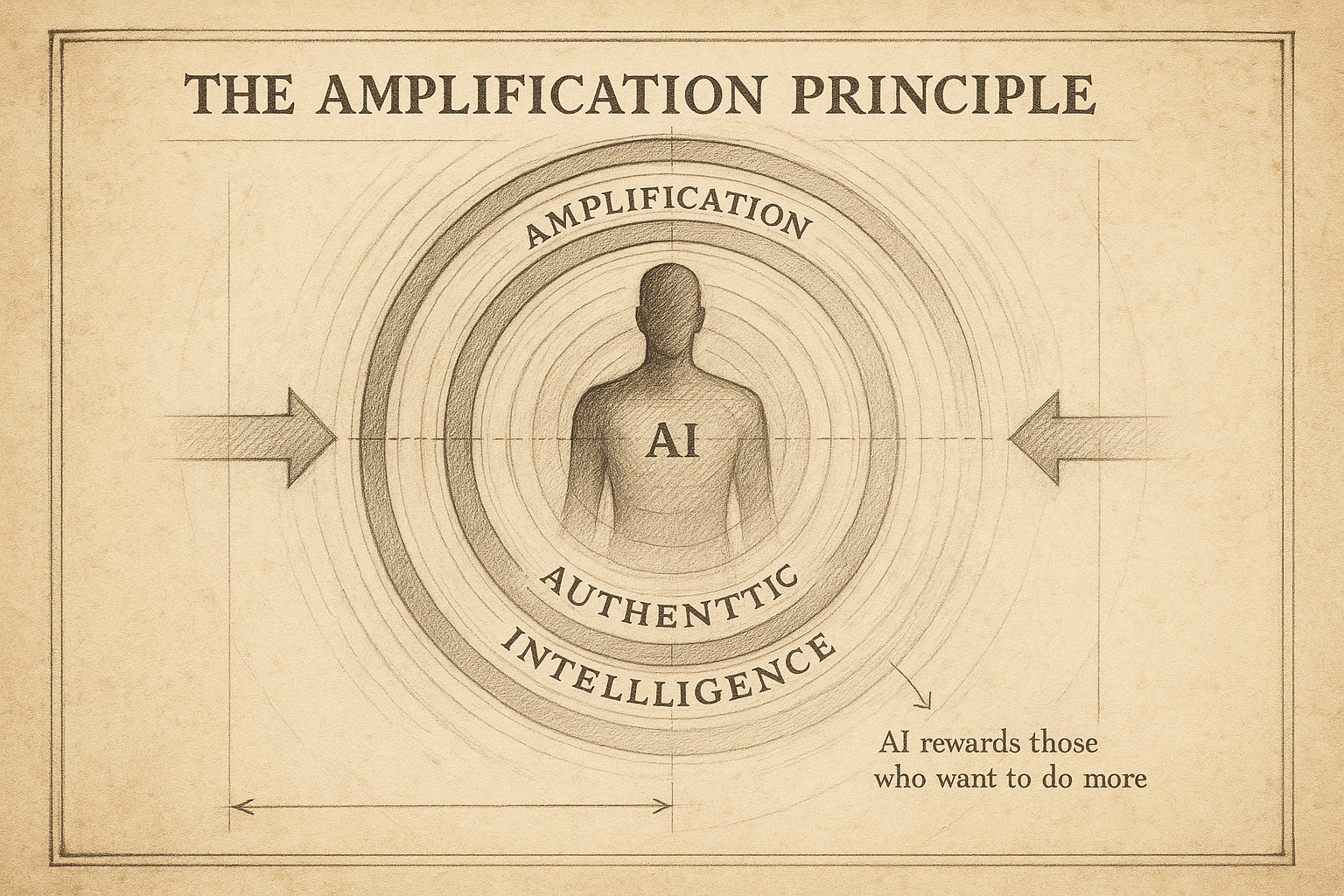
But here’s what the headlines miss: AI doesn’t make the case for doing less. It amplifies those who want to do more.
The organizations that understand this are building competitive advantage right now. Not because they’ve adopted the latest AI platform, but because they’ve reframed what AI actually does — and who it serves best.
The Replacement Myth
The story we keep hearing about AI is fundamentally a replacement story. AI will replace writers, replace analysts, replace strategists, replace anyone whose work involves knowledge rather than physical labor.
This narrative serves a particular vision of efficiency: do the same work with fewer people, produce the same output at lower cost, optimize for reduction.
But this vision misunderstands both what AI is good at and what actually creates value in knowledge work.
AI excels at pattern recognition, data synthesis, and rapid iteration across known solution spaces. It struggles with judgment calls in ambiguous situations, understanding unstated context, and building the human relationships that underpin real strategic work.
More importantly, this replacement framing assumes that the constraint on value creation is the cost of human effort. In reality, the constraint is almost always human attention, judgment, and the depth of understanding that comes from genuine curiosity.
The replacement myth assumes scarcity of human capacity. The reality is scarcity of human focus on what actually matters.
Amplification, Not Automation
Here’s what we’ve learned building AI systems for strategic work: the people who get the most value from AI aren’t those looking to do less. They’re the ones looking to go deeper.
When we built our Discovery process (the AI-enhanced conversation methodology that crystallizes a client’s strategic situation) we discovered something counterintuitive. The AI didn’t make conversations shorter or simpler. It made them richer.
Instead of spending mental energy remembering every detail or organizing notes in real-time, you can focus entirely on understanding what the person across from you is actually trying to accomplish. The AI handles research, pattern extraction, and synthesis. You handle judgment, connection, and the questions that reveal what really matters.
This is amplification. The human element isn’t reduced. It’s freed to operate at a higher level.
What “Authentic Intelligence First” Actually Means
We use the phrase “Authentic Intelligence” not as marketing copy but as design principle: focus on authentic intelligence first, then amplify with artificial intelligence.
In practice, this means asking different questions when evaluating AI opportunities:
Replacement thinking asks: “What tasks can we eliminate?” Amplification thinking asks: “What would we do if the constraint wasn’t time?”
Replacement thinking asks: “How do we reduce headcount?” Amplification thinking asks: “How do we deepen capability?”
Replacement thinking asks: “Can AI do this job?” Amplification thinking asks: “What can humans do better when they’re not doing this?”
The frame shifts from elimination to elevation. Not “what can we get rid of” but “what becomes possible.”
This isn’t naive humanism pretending AI doesn’t change things. It absolutely does. But the change isn’t replacement — it’s a shift in where human effort creates the most value.
The Competitive Advantage of Curiosity
Here’s the strategic implication that matters for your organization: AI creates a competitive advantage for those with a growth mindset.
If you approach AI as a cost-reduction tool, you’ll optimize for doing the same things with less. You might improve margins temporarily, but you’re not building anything new.
If you approach AI as an amplification tool, you optimize for doing more — exploring deeper, moving faster, connecting patterns across wider domains.
The executive who sees AI as a replacement for learning stops investing in understanding. They outsource thinking to the tool.
The executive who sees AI as amplification for learning doubles down on understanding. They use the tool to explore faster, validate ideas more thoroughly, and connect insights across domains they wouldn’t have time to master otherwise.
Over time, these two approaches diverge radically in capability. One organization knows less about its domain because it’s delegated knowing to automation. The other knows vastly more because it’s used automation to expand what’s knowable within the time available.
The organization that treats AI as a replacement for human judgment will produce commodity work faster. The organization that treats AI as amplification for human judgment will produce insights their competitors can’t match.
What This Looks Like in Practice
We see this pattern in how our clients engage with our Discovery process and our framework-guided methodology.
The clients who struggle are the ones who want to hand off responsibility. They treat AI-enhanced processes like vendor services: “Here’s what I need, go build it.” They disengage from the process.
The clients who thrive treat AI as collaborative intelligence. They bring deep context, ask probing questions, challenge assumptions, and stay engaged in the strategic thinking. The AI handles research, synthesis, and technical execution. The human handles judgment calls, priority setting, and understanding the nuances that don’t fit in documentation.
The result isn’t just better technical output. It’s deeper organizational understanding of what they’re actually trying to accomplish and why.
This is what amplification looks like at the ground level: humans doing more of what humans are uniquely good at because they’re not doing what machines can handle.
The Organizations That Will Win
The competitive landscape is splitting into two camps.
Camp One sees AI as a way to do the same work cheaper. They’re optimizing for efficiency within existing categories. They’re reducing learning, reducing exploration, reducing the “expensive” human judgment that slows down execution.
Camp Two sees AI as a way to do work that wasn’t previously possible. They’re optimizing for capability expansion. They’re accelerating learning, deepening exploration, and freeing human judgment to operate on harder problems.
Camp One will produce commodities efficiently. Camp Two will create new categories entirely.
The difference isn’t access to better AI tools. Both camps have the same technology available. The difference is philosophical: what do you believe AI is for?
If you believe AI is for replacement, you build systems that minimize human input. If you believe AI is for amplification, you build systems that maximize human judgment.
One approach treats people as the expensive problem. The other treats people as the strategic asset.
The Path Forward
The anxiety about AI replacement is understandable. But it’s misplaced.
The real risk isn’t that AI will replace human capability. It’s that organizations will choose replacement thinking when amplification thinking would build lasting advantage.
You can respond to AI by asking “what can we eliminate?” or by asking “what becomes possible?” Both are rational responses to new technology. But they lead to radically different futures.
The organizations that win won’t be those who automated away their need for human judgment. They’ll be the ones who freed human judgment to operate at a level that wasn’t previously accessible.
AI doesn’t make the case for learning less. It amplifies those who want to learn more.
The question for your organization isn’t whether to adopt AI. It’s whether you’ll use it to replace what’s human or amplify it.
We believe technology changes, but being human doesn’t. The need for judgment, creativity, and genuine understanding isn’t going away. It’s becoming more valuable precisely because AI can handle everything else.
The strategic opportunity isn’t efficiency. It’s elevation.
Ready to explore amplification?
Schedule Discovery Call → 60-minute conversation, Clarity Document within 48 hours. No obligation.
Apply for Research Partnership → Collaborative exploration for organizations ready to go deep.