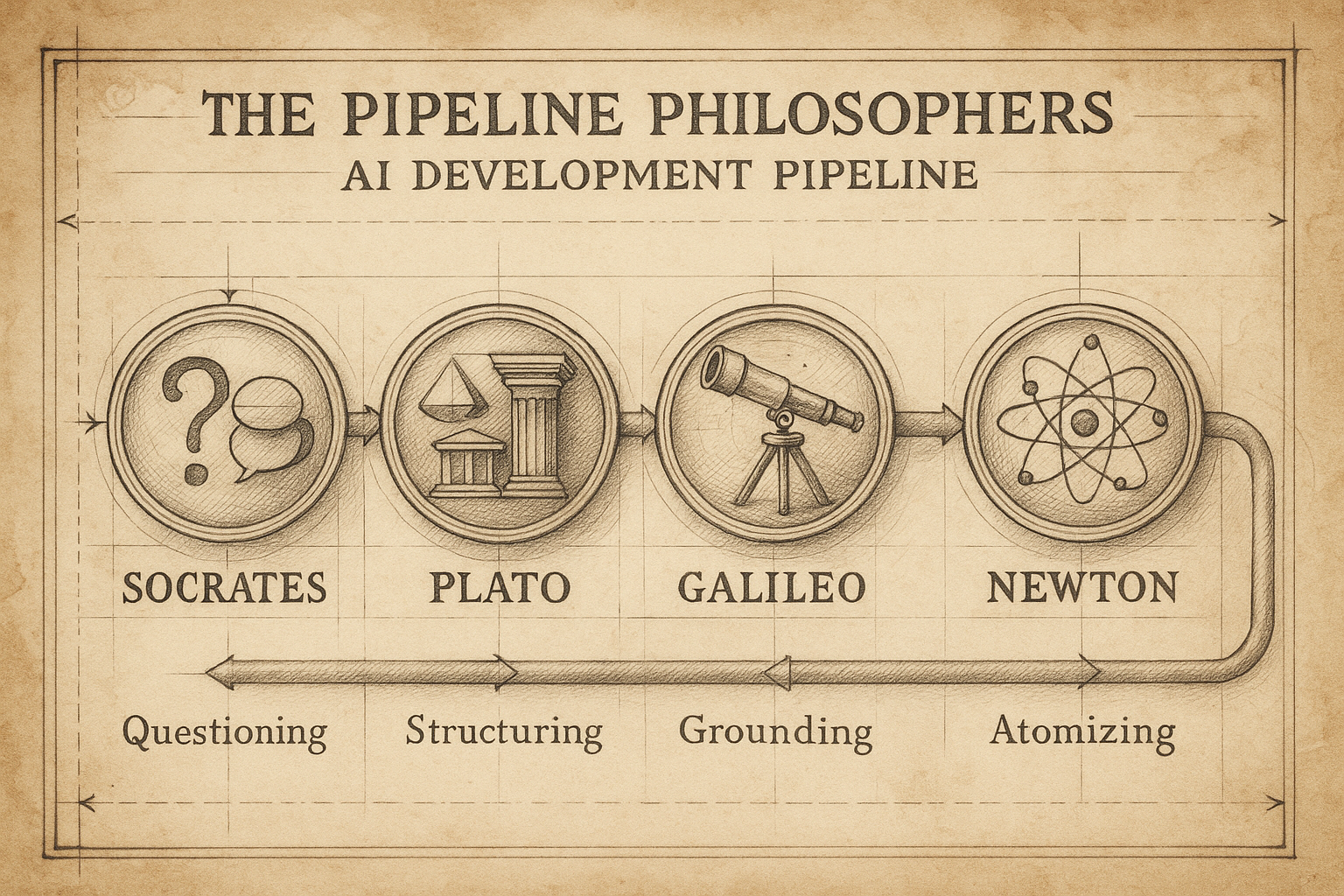
Names matter. When most companies name their AI tools, they reach for something that sounds technical and impressive—“Optimizer Pro” or “Insight Engine X.” We went a different direction. Our AI pipeline stages are named Socrates, Plato, Galileo, and Newton.
Not because we’re trying to sound smart. Because those names represent something essential about how we think AI development should actually work.
The Discovery Theme: What Connects These Thinkers
What do these four historical figures have in common? They weren’t content with the status quo. They asked uncomfortable questions. They challenged prevailing wisdom. They built systematic frameworks for understanding complexity. Most importantly, they each brought a different cognitive mode to their work—modes that remain essential to good thinking today.
Socrates questioned assumptions until truth emerged. Plato created structures to organize complex ideas. Galileo grounded theory in observable evidence. Newton built atomic frameworks that made prediction possible.
Sound familiar? It should. Because that’s exactly what good AI development requires.
We named our approach after history’s greatest minds because we believe AI development deserves the same rigor they brought to understanding the universe. These weren’t people who guessed. They were disciplined thinkers who created systematic approaches to hard problems.
That’s what we’re trying to do with AI. Not chase hype, but build something that actually works.
Socrates: The Questioner
“The unexamined assumption is the foundation of expensive problems.”
Socrates didn’t provide answers. He asked questions. Relentlessly. The Socratic method starts with what you think you know and systematically reveals what you’ve assumed, what’s unclear, and where gaps exist.
Our Socrates stage does the same thing at the beginning of every project. It slows everything down—intentionally. While others are racing toward implementation, Socrates is asking:
- What problem are you actually trying to solve?
- What assumptions are you making about how this will work?
- Where might your vision conflict with reality?
- What gaps exist between intent and execution?
This isn’t pedantic. It’s essential. Because the assumptions you don’t surface at the beginning become the problems you discover halfway through. The questions you don’t ask become the misunderstandings that derail projects.
We named this stage Socrates because questioning is its own cognitive mode. It requires patience, intellectual honesty, and the courage to admit you might not have it all figured out yet. Most AI implementations skip this step entirely—and pay for it later.
Socrates makes sure the vision is clear, shared, and strong enough to guide everything that follows. Not because it’s philosophically satisfying, but because it prevents expensive rework.
Plato: The Architect
“Before you can build anything, you must know what you’re building.”
If Socrates reveals what’s unclear, Plato makes it concrete. Where Socrates operates in questions, Plato operates in structure.
Plato the philosopher wasn’t just interested in abstract ideals. He created frameworks for organizing knowledge—Forms, the divided line, the allegory of the cave. He gave structure to complexity.
Our Plato stage takes the clarity Socrates creates and turns it into requirements. Real, buildable requirements. Not vague aspirations like “make it scalable” or “ensure security.” Specific, documented answers to practical questions:
- What are the actual constraints we’re working within?
- What risks exist at the architectural level?
- What dependencies matter across security, operations, and business needs?
- What trade-offs are we willing to make?
This is where ideas gain substance. Plato works with both technical systems and human stakeholders to ask practical questions and document clear answers. The result isn’t a philosophical treatise—it’s a solid requirements foundation aligned with the original vision while accounting for real-world constraints.
We named this stage Plato because architecture is its own cognitive mode. It requires seeing both the ideal and the practical. It demands systematic thinking about structure, relationships, and constraints. Plato gives us that—a mind that organizes complexity into buildable plans.
Galileo: The Observer
“Evidence before execution. Observation before action.”
Galileo changed how humanity understood the universe—not by theorizing more elegantly than his predecessors, but by looking more carefully. He observed. He measured. He grounded theory in evidence.
Empiricism matters in AI development too.
Our Galileo stage takes well-defined requirements and maps how work will actually unfold in practice. This isn’t just creating a task list. It’s systematic planning that accounts for:
- What needs to happen first, and why
- What can run in parallel without creating conflicts
- Where bottlenecks will appear
- What dependencies exist across the work
Galileo breaks projects into epics, stories, and tasks with clear sequencing. It focuses on complexity and risk so the plan makes sense before execution begins.
We named this stage Galileo because planning requires observation—not wishful thinking. You can’t plan effectively if you ignore evidence about how work actually gets done. Galileo reminds us to think ahead systematically, to see the path before we walk it.
Too many AI implementations leap from requirements straight to code. Galileo ensures we’re following a plan that’s already been thought through carefully. Teams aren’t guessing their way through the work—they’re following evidence-based sequencing.
Newton: The Builder
“Atomic units. Deterministic execution. Predictable outcomes.”
Newton didn’t just describe gravity abstractly. He gave us equations. Predictable, testable, atomic formulas that made complex motion understandable and calculable.
That’s what our Newton stage does for implementation.
Newton takes the implementation plan Galileo created and breaks it down even further—into small, self-contained work units. Each unit includes:
- Clear context for why this work matters
- Specific instructions for what needs to happen
- Success criteria for knowing when it’s done correctly
This is where planning becomes progress. Where strategy becomes code. Where abstract vision becomes concrete reality.
We named this stage Newton because execution requires precision. Not vague directives, but atomic clarity. When every action is clear and accounted for, complex projects become manageable. When work is broken down precisely, tasks can be completed in parallel without losing quality or control.
Newton makes execution predictable and scalable. Each step is verified before moving forward. Nothing is left to guesswork. Just like Newton’s laws describe motion with mathematical precision, our Newton stage ensures every implementation step has deterministic clarity.
Why This Approach Matters for AI Development
Here’s the uncomfortable truth about AI development: most of it fails. Not because the models aren’t powerful enough. Because the thinking isn’t clear enough.
People rush from vague ideas straight to implementation. They skip the questioning phase (Socrates). They don’t document requirements properly (Plato). They don’t plan systematically (Galileo). They don’t break work into atomic units (Newton).
Then they wonder why their AI projects produce hallucinations, miss requirements, or deliver something that doesn’t actually solve the problem.
We named our pipeline after philosophers and scientists because systematic thinking matters. Because different cognitive modes serve different purposes. Because rushing to answers before you’ve asked the right questions is a recipe for expensive failure.
Socrates forces clarity before commitment. Plato demands structure before building. Galileo requires planning before execution. Newton ensures precision during delivery.
This isn’t theory. This is how we build AI systems every day. These stages aren’t marketing concepts—they’re working methodology we’ve developed to create reliable outcomes.
When you separate clarity, requirements, planning, and execution into distinct cognitive modes, something important happens: you slow thinking down in the right places. You reduce guesswork and hallucinations. You create predictable outcomes.
That’s Authentic Intelligence. Not AI that replaces human judgment, but AI that amplifies systematic thinking by embodying different modes of reasoning.
What This Means for Your Organization
If you’re exploring AI implementation, consider this:
Are you starting with Socratic questioning, or rushing to solutions? Are you creating Platonic structure, or building on vague requirements? Are you planning with Galilean evidence, or hoping for the best? Are you executing with Newtonian precision, or relying on guesswork?
The difference isn’t philosophical—it’s practical. It’s the difference between AI that works and AI that disappoints.
We named our approach after history’s greatest minds because we believe your AI implementation deserves that level of rigor. Because the same systematic thinking that helped humanity understand the universe can help you build AI systems that actually deliver.
Technology changes. What it takes to think clearly doesn’t.
Ready to experience this approach?
Meet the Team → Learn more about Socrates, Plato, Galileo, and Newton—and the human experts who guide them.
Schedule Discovery Call → Experience our Socratic questioning process firsthand. Get a Clarity Document crystallizing your AI challenges and opportunities.
Explore Research Partnership → For organizations ready to go deep, where both parties invest and both benefit.